A new way to correct patient identity, in real time
At CVS Health, Saiteja invented the explode-and-rematch method, a new way for the platform to correct wrongly merged patient records. Before it, a person judged each whole cluster by hand and corrections ran in batch. He built two production systems to carry it: the overmatch resolver and the real-time demographic events service. The architecture review board made his enterprise event taxonomy the required standard.
~40%
less manual reconciliation of overmatched records
Seconds
for a correction to reach 14 lines of business, down from hours
~150
transactions per second on the events service
10+
teams building on his enterprise event taxonomy
Production figures from the CVS Health patient-identity platform. Saiteja, a Senior Cloud Engineer, has been lead designer of these systems since October 2024.
The problem
An overmatch is a set of linked records that may not belong to the same person. It can put one patient's record in front of a clinician who is treating someone else. At CVS Health, which serves more than 185 million people, overmatched records were untangled by hand, and the platform had no safe way to undo an overmatch at production speed.
185 million is the reach of the organisation, not a personal count. An industry estimate from Black Book Research puts the cost of inaccurate patient identification at more than 6.7 billion dollars a year.
What he set out to do
He set out to invent a method that corrects overmatches automatically, does not join an uncertain match automatically, and puts the corrected identity in front of clinicians in seconds.
From July 2021 to October 2024 he worked on real-time payment decisions at PayPal, where an automated decision had to be right at volume. He applied the same standard to patient identity at CVS Health.
The invention in five steps
Instead of a person judging a whole cluster, the method breaks the cluster apart and matches each record again on its own evidence.
What was new was not splitting a record, which people already did by hand, but letting the platform do it: each record is rematched on its own evidence, only a high-confidence match completes automatically, and the correction reaches every line of business as one event.
1A wrong merge
Records that may belong to different people are linked as one identity.
2Explode the cluster
The overmatched cluster is broken into its separate records.
3Rematch each record
Each record is matched again, independently, on its own evidence.
4Apply the confidence rule
A high-confidence match completes automatically. A low-confidence match goes to a person.
5Publish the correction in real time
The correction is published as an event and reaches 14 lines of business in seconds.
Two systems, both still in production
Overmatch resolver
This system runs the explode-and-rematch method. It separates wrongly merged records, rematches each one independently, and applies the confidence rule.
BeforeA person judged a whole cluster by hand
AfterOnly low-confidence matches reach a person
~40%less manual reconciliation
An uncertain match goes to a person and is no longer written as certain, which lowers the risk of a false merge reaching clinicians and pharmacists at the point of care.
Real-time demographic events service
A Spring Boot application with cloud streaming pipelines. He replaced batch processing with an event-driven design and defined the enterprise event taxonomy, so a demographic change has one meaning across the platform.
BeforeCorrections ran in batch and took hours
AfterCorrections reach 14 lines of business in seconds
~150transactions a second
All 14 lines of business read the same event, with one meaning for each demographic change.
His role
Invented the explode-and-rematch method
Lead designer of both production systems
Defined the enterprise event taxonomy
Wrote the design proposal and presented it to the architecture review board
Ran the working sessions that brought other teams onto the taxonomy
Reviews every design that touches the identity path before it proceeds
Tuned the platform's analytical storage and queries, so analytical queries run up to 70 percent faster
From proposal to enterprise standard
Design proposalWritten by Saiteja
Architecture review boardHe presented the proposal
Required enterprise standardThe board made his taxonomy the standard
10+ teamsNow build on his taxonomy
The two systems transformed the way the business corrects patient identity. High-confidence matches now complete without waiting for a later manual review, and low-confidence matches still go to a person. More than ten teams now build on his taxonomy, so the standard is used well beyond his own team.
Related research
Six papers, three of them sole-authored. Three study questions close to the invention: patient matching, privacy-preserving record linkage, and data quality in healthcare pipelines. None of the papers describes the CVS Health systems above, and every figure below is a study result on the data shown, not a production metric. The IJCA and ICCBI papers are published, the INTCEC, UEMCON, and HealthCom papers were presented at IEEE conferences in 2026, and the ICCCN paper is accepted. Full record on Google Scholar and ORCID 0009-0005-4339-6417.
Patient identity and healthcare data
01
Sole author Published
Generative AI for Synthetic Patient Data Generation to Enhance Identity Matching and Deduplication Models
International Journal of Computer Applications, Volume 187, Number 103, May 2026
Recall rose from 0.45 to 0.95 against the deterministic baseline
On 389 synthetic patient records, expanded to 778 candidate pairs, the GAN-augmented model reached recall 0.95 and F1-score 0.94. The deterministic baseline had recall 0.45 and F1-score 0.61, and a hybrid model had the highest F1-score, 0.95. Missing data was the hardest error type, and phonetic variation the easiest.
Synthetic patients let matching models be tested against realistic errors without exposing real patient records.
What the paper did
Generative adversarial networks and variational autoencoders create synthetic patient records that carry deliberate clerical errors, such as phonetic misspellings and reversed digits. Deduplication models trained on that data are compared with deterministic, probabilistic, and neural network baselines.
Data
389 synthetic cases from the Synthea patient population simulator
Tools
TensorFlow, RecordLinkage, Pandas
The deterministic baseline is precise but misses most matchesPrecision and recall, five models
Source: Table 1. Recall axis starts at 0.4, precision axis at 0.85.
Recall rose from 0.45 to 0.95 with GAN-augmented dataDeterministic baseline against the GAN-augmented model
Source: Table 1. Axis starts at 0.4.
Missing data hurt matching the mostMatching success by error type and noise level
Salt-Hashed Bloom Filter Encoding for Privacy-Preserving Patient Record Linkage in Distributed Healthcare Systems
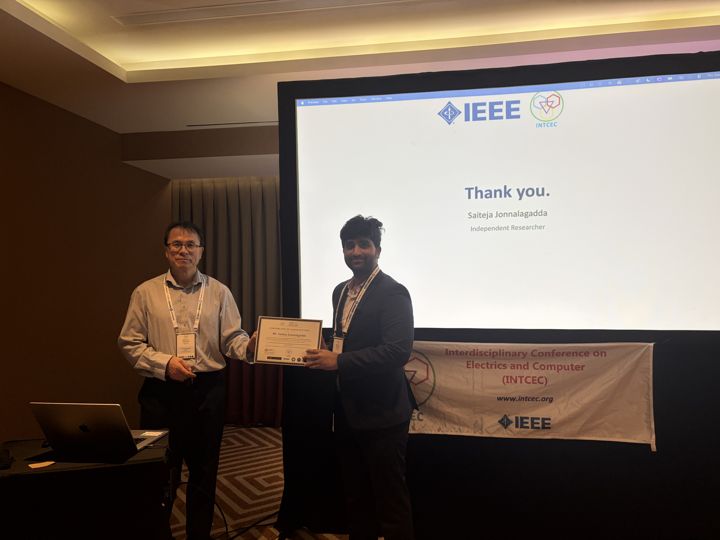
IEEE INTCEC 2026, Chicago, 24 to 25 September 2026, oral presentation
48 of 50 duplicate pairs found from encoded records
On 395 synthetic records with 50 known duplicate pairs, the method identified 48 of 50 pairs, with one false positive. The two missed pairs had dissimilar zip code and surname fields. The hybrid encoding reached accuracy 0.98.
Records held in separate systems can be linked while the identifiers stay encoded.
What the paper did
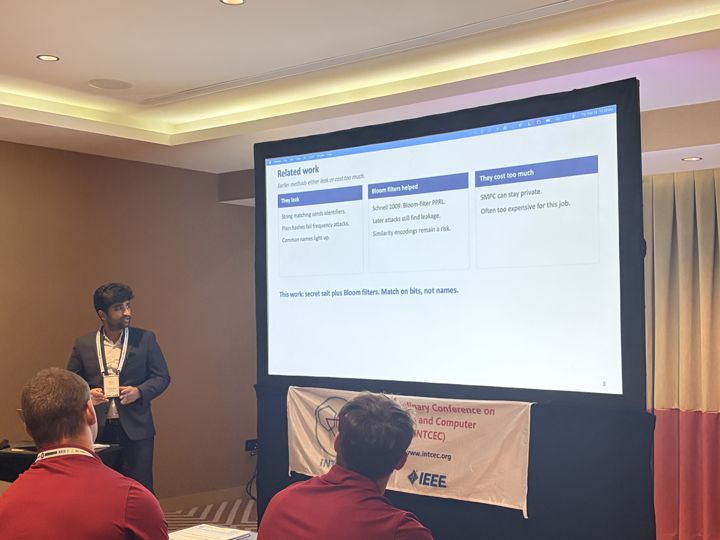
Sensitive attributes are turned into salted cryptographic tokens inside Bloom filters, so records from separate systems can be compared without exposing clear-text personal data. Five encoding variants and five attribute sets are compared.
Data
395 synthetic health record identities with 50 known duplicate pairs
Tools
Python hashlib and cryptography libraries, Python Record Linkage Toolkit
48 of the 50 known duplicate pairs were foundEach square is one true duplicate pair
Source: results text, 395 synthetic records. One further pair was linked in error.
More accurate encodings took longerAccuracy and processing time, five encoding variants
Source: Table I. Axis starts at 0.86.
The full profile gave the fewest errorsFalse positives and false negatives by attribute set
Protecting Model Reliability with Automated Data Quality and Observability for Healthcare Machine Learning Pipelines
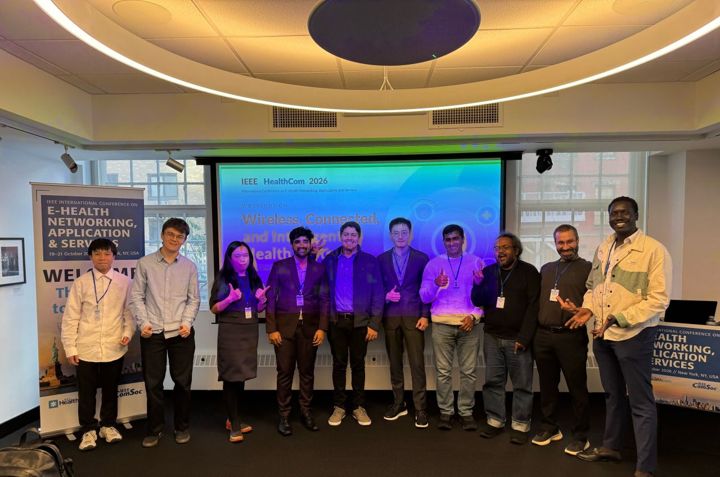
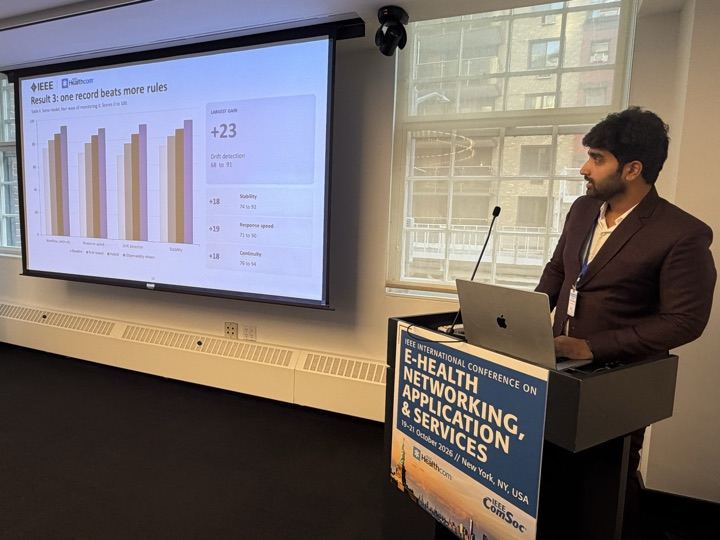
IEEE HealthCom 2026 (WCIHS), presented in New York, 19 to 21 October 2026, with Ramesh Kumar Ramu
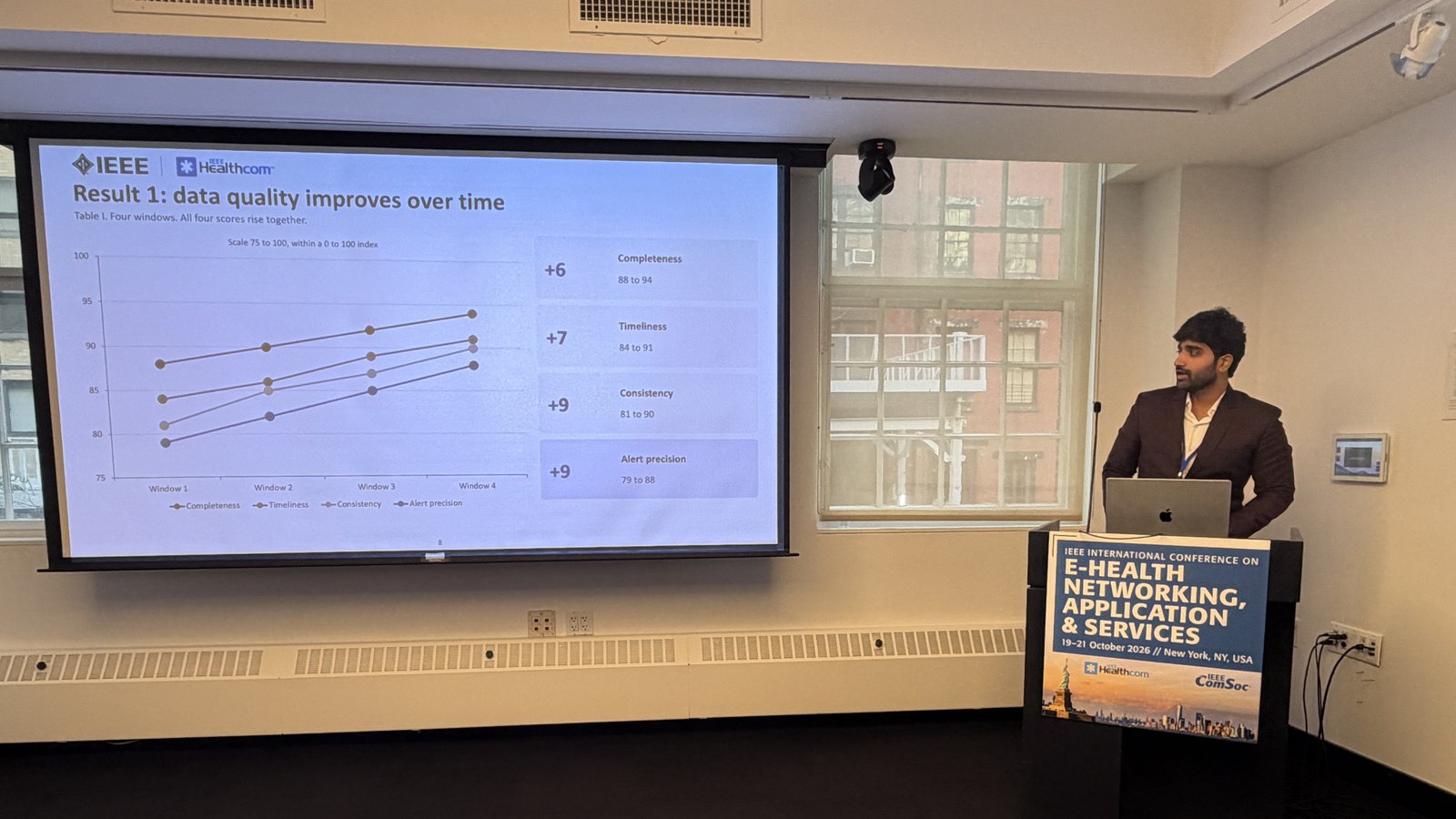
Observability-driven monitoring scored higher than the baseline on all four measures in this study
On 169 study-generated pipeline instances with no identifiable patient information, observability-driven monitoring scored stability 92, drift detection 91, response speed 90, and workflow continuity 94, against baseline scores of 74, 68, 71, and 76. Those figures are 0 to 100 evaluation scores for this study.
The study tests checks that stop poor input data before it reaches a model. Its scores are study results, not clinical accuracy.
What the paper did
One runtime path joins a data-quality gate (required fields, freshness, expected ranges, duplicate patterns), feature validation, inference monitoring, observability, and clinical feedback. Four monitoring strategies are compared.
Data
169 study-generated healthcare pipeline instances with no identifiable patient information
Real-Time AI Driven Anomaly Detection for Fraud Prevention in High-Volume Financial SystemsIEEE UEMCON 2026, oral presentation, Armonk, New York, 7 to 9 October 2026. Sole author.Review delay at or under 2.3 seconds on every channel. Google Scholar
Enhancing API Security in Spring Boot Microservices Using AI-Based Threat DetectionIEEE ICCBI 2026, 5th International Conference on Computer Networks, Big Data and IoT, with Manju George. Co-author.F1-score 0.93, with a latency of 12.5 milliseconds against a 20-millisecond threshold. IEEE Xplore, DOI 10.1109/ICCBI68589.2026.11619655
AI-Driven Framework for Adaptive Encryption and Intelligent Monitoring in Secure Data SystemsICCCN 2026, with Satyanarayana Gadiraju and Manju George. Co-author.Detection of 94 percent or higher. In low-risk periods, lighter encryption used almost 30 percent less computation than a fixed high-security setting. Google Scholar